



A new job in Austin. A remarriage in Seattle. A chance to move closer to aging parents in Boston. Life happens, and sometimes a parent with a California custody order gets an opportunity that requires relocating with the children. What many parents do not realize is that moving a child out of state, or even a meaningful distance within California, is one of the most legally complex decisions in family law. Do it wrong, and you can lose custody.
California move-away law is specific, technical, and deeply tied to the facts of each case. Here is what every parent needs to understand before signing a lease, accepting a job offer, or packing a single box.
What Counts as a Move-Away in California?
A move-away is any relocation by a parent that significantly impacts the other parent’s ability to maintain the current custody schedule. There is no bright-line mileage rule. A move from Irvine to Temecula may not qualify, while a move from Newport Beach to Fresno almost certainly does. The test is practical: can the existing parenting plan continue to function, or does the move require a new schedule?
In general, if the relocation will prevent the non-moving parent from exercising their regular time under the current order, the court will treat it as a move-away and apply the move-away analysis. This is true whether the move is across state lines, to another country, or to a distant California county.
Do You Have Sole or Joint Custody? It Changes Everything
California move-away cases are analyzed under two different legal standards, and the standard depends on whether the moving parent has sole physical custody or the parents share joint physical custody.
Sole Physical Custody: The Burgess Standard
Under In re Marriage of Burgess (1996), a parent with sole physical custody has a presumptive right to move with the children. The burden shifts to the non-moving parent to show that the move would be detrimental to the children. This is a high bar. Without evidence of real harm, the move will likely be allowed.
Joint Physical Custody: The LaMusga Standard
Under In re Marriage of LaMusga (2004), when parents share joint physical custody, neither parent has a presumptive right to move. The court conducts a full best-interest analysis, weighing a list of factors (discussed below). The moving parent is not guaranteed permission, even for legitimate reasons.
Why the Label on Your Order Matters
This is why the words in your custody order matter so much. An order that labels the custody arrangement as “joint” can produce a dramatically different result than one that labels it as “sole physical custody to Parent A with visitation to Parent B,” even if the day-to-day schedule is similar. Parents considering a future move should review their order with an experienced child custody attorney long before the move becomes real.
The Notice Requirement: Why Timing Matters
California Family Code Section 3024 requires a parent to give at least 45 days written notice before any planned relocation of the children. The notice allows the other parent to either negotiate a new schedule or file a motion to prevent the move.
Skipping this notice is one of the most common and most damaging mistakes in move-away cases. Courts view a unilateral move as a serious red flag. Judges have ordered children returned from out of state, awarded custody to the non-moving parent, and imposed sanctions on parents who moved first and asked permission later. If you are considering a relocation, treat the notice requirement as non-negotiable.
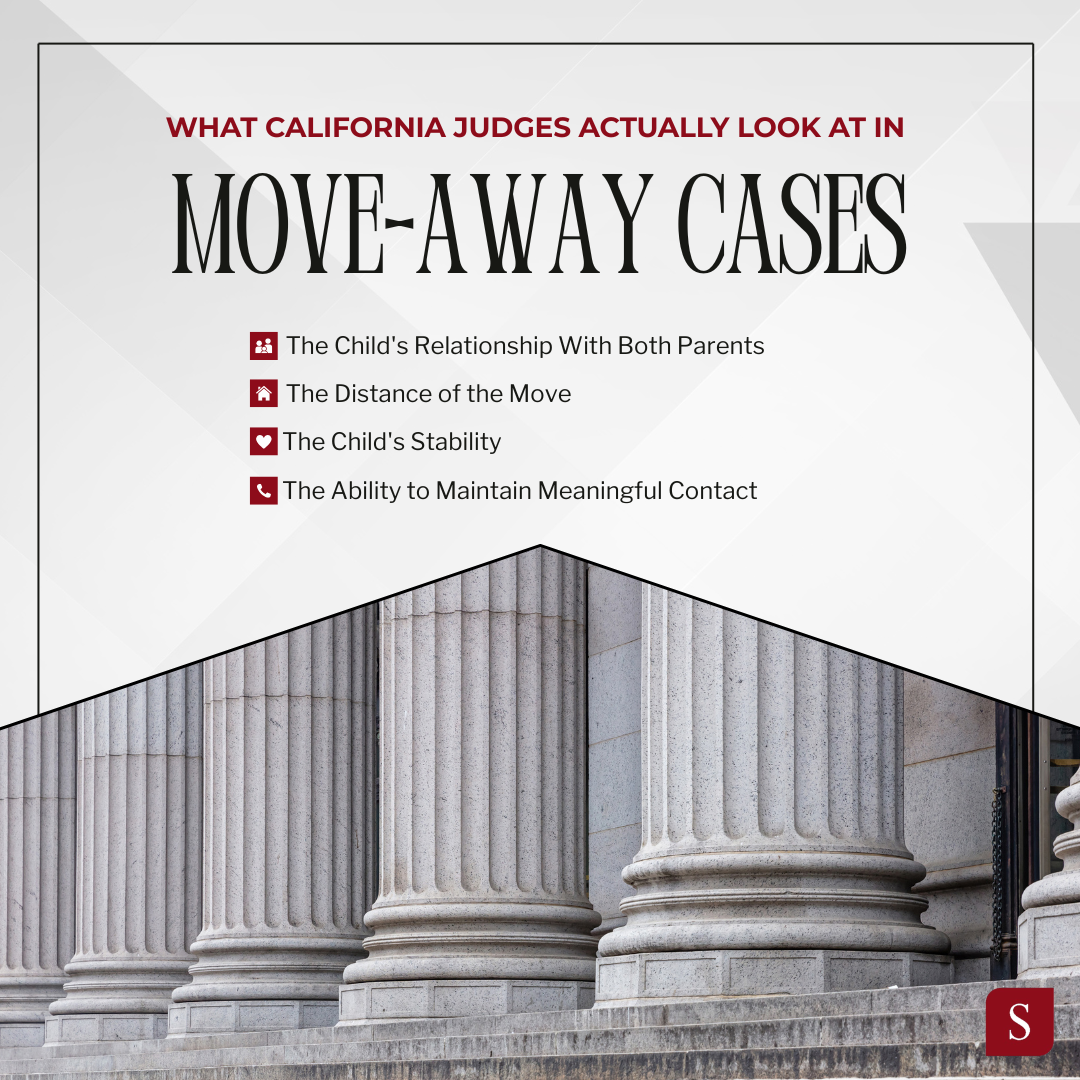
The Best-Interest Factors California Courts Apply
In joint custody cases, and in sole custody cases where detriment is alleged, the court evaluates a long list of factors. These come from LaMusga and subsequent case law:
- The children’s interest in stability and continuity in the existing custodial arrangement
- The distance of the proposed move
- The age of the children
- The children’s relationship with both parents
- The relationship between the parents and their ability to co-parent across distance
- The wishes of children who are of sufficient age and maturity
- The reasons for the proposed move
- The extent to which the parents are currently sharing custody
- The children’s community ties, schools, and extracurriculars
- Whether the proposed move is in good faith or designed to frustrate the other parent’s contact
Common Reasons Parents Propose a Move
Employment and Financial Opportunity
A legitimate job offer, especially one that materially improves the family’s financial picture, carries significant weight. Courts understand that economic stability benefits children. The moving parent should be prepared with documentation: offer letters, salary comparisons, cost of living analysis.
Family Support
Moves to be closer to extended family often succeed when the moving parent can show a real support network at the destination. Grandparents who can help with childcare, siblings, or a tight community can all be factors in the children’s best interest.
Remarriage or a New Relationship
These are the trickiest moves. Courts scrutinize them carefully because they can look like the moving parent prioritizing their new relationship over the children’s bond with the other parent. Detailed planning and evidence of how the children will benefit are essential.
Safety or Domestic Violence Concerns
If the move is motivated by documented safety concerns, including patterns of domestic violence, the court may view the relocation very differently. These cases often move faster and involve different procedural protections.
What the Non-Moving Parent Can Do
If you are the non-moving parent and you just received a relocation notice, do not wait. You have options, but they have deadlines.
File a Request for Order
You can file a motion asking the court to prevent the move, modify custody so the children stay with you, or order a custody evaluation. The sooner you file, the more time the court has to evaluate the case on the merits rather than granting temporary permission under time pressure.
Request a 730 Evaluation
In contested move-away cases, a California Evidence Code Section 730 custody evaluator often plays a central role. The evaluator interviews both parents, the children, and collateral witnesses, then recommends what is in the children’s best interest. Judges give these reports substantial weight.
Propose a Revised Schedule
If the move is likely to be approved, shifting your strategy to negotiating a strong long-distance schedule may produce a better outcome than a losing legal battle. Extended summer and holiday time, frequent virtual contact, and shared travel costs can preserve a meaningful relationship even across distance.
When a Move-Away Case Becomes Urgent
Some situations require emergency action. If a parent has already taken the children out of state without notice, or is about to, an ex parte motion may be appropriate. If there are concerns about international abduction, special protective orders and passport controls can be put in place. These are complex, fast-moving cases where a day of delay matters.
Evidence That Moves the Needle
Move-away cases are not decided on emotion or intuition. Judges want documentary evidence that supports the claims each parent is making. Strong move-away cases typically include some combination of the following:
- Written job offers, salary comparisons, and relocation packages
- Cost of living analyses showing the financial impact of the move
- Housing documentation at the destination
- School research comparing academic quality, class size, and special services
- Evidence of extended family support, including declarations from grandparents or siblings
- A detailed proposed parenting plan for after the move
- Communication logs showing attempts to resolve the issue with the other parent
Parents who show up prepared tend to be taken seriously. Parents who rely on generalities about opportunity or parental bond without concrete evidence often leave the courtroom disappointed.
The Role of a Custody Evaluator
In contested move-away cases, a neutral mental health professional is often appointed under California Evidence Code Section 730. The evaluator’s job is to assess the family, interview the children in age-appropriate ways, and provide the court with a recommendation about what arrangement best serves the children’s interests. These evaluations typically take several months and can cost between $10,000 and $40,000, split between the parents.
Parents should prepare for a 730 evaluation as carefully as they prepare for trial. Being truthful, respectful, and focused on the children, rather than on grievances against the other parent, is the single most important factor in how the evaluator assesses you.
Protecting Your Family Before a Move-Away Dispute
The best move-away case is the one that never has to be filed. Parents who work proactively, whether they are planning a move or worried about one, tend to get better outcomes than those who react after the fact. Review your custody order, understand what it actually says about relocation, and get legal advice before you make major commitments.
The attorneys at Sullivan Law & Associates handle move-away and relocation cases throughout Orange County and Southern California. Whether you are the parent considering a move or the parent receiving a notice, we can help you evaluate your position, protect your relationship with your children, and build the strongest possible case. Contact our office for a confidential consultation.