



Move-away cases are some of the hardest family law cases in California, and they rarely turn on a single fact. When a parent asks the court for permission to relocate with the children, or opposes a proposed relocation, the judge is not looking for a winner and a loser. The judge is looking for the arrangement that best protects the children’s long-term well-being.
Parents often walk into these hearings focused on what feels most urgent to them: the job offer, the new home, the other parent’s attitude. Judges look at a much broader picture. Understanding what California courts actually weigh can help parents prepare a realistic case and avoid the mistakes that undermine otherwise strong positions.
The Legal Framework: Burgess, LaMusga, and Best Interest
Every move-away case runs through the framework set by In re Marriage of Burgess (1996) and In re Marriage of LaMusga (2004). Burgess gives a sole physical custody parent a presumptive right to move, shifting the burden to the other parent to show detriment. LaMusga governs joint custody situations and requires a full best-interest analysis.
In both frameworks, the touchstone is the children’s best interest. Judges are not trying to punish a moving parent for wanting a better life, and they are not trying to trap a non-moving parent into accepting a decision that hurts their relationship. They are trying to figure out which outcome causes the least disruption and produces the healthiest long-term result for the children.
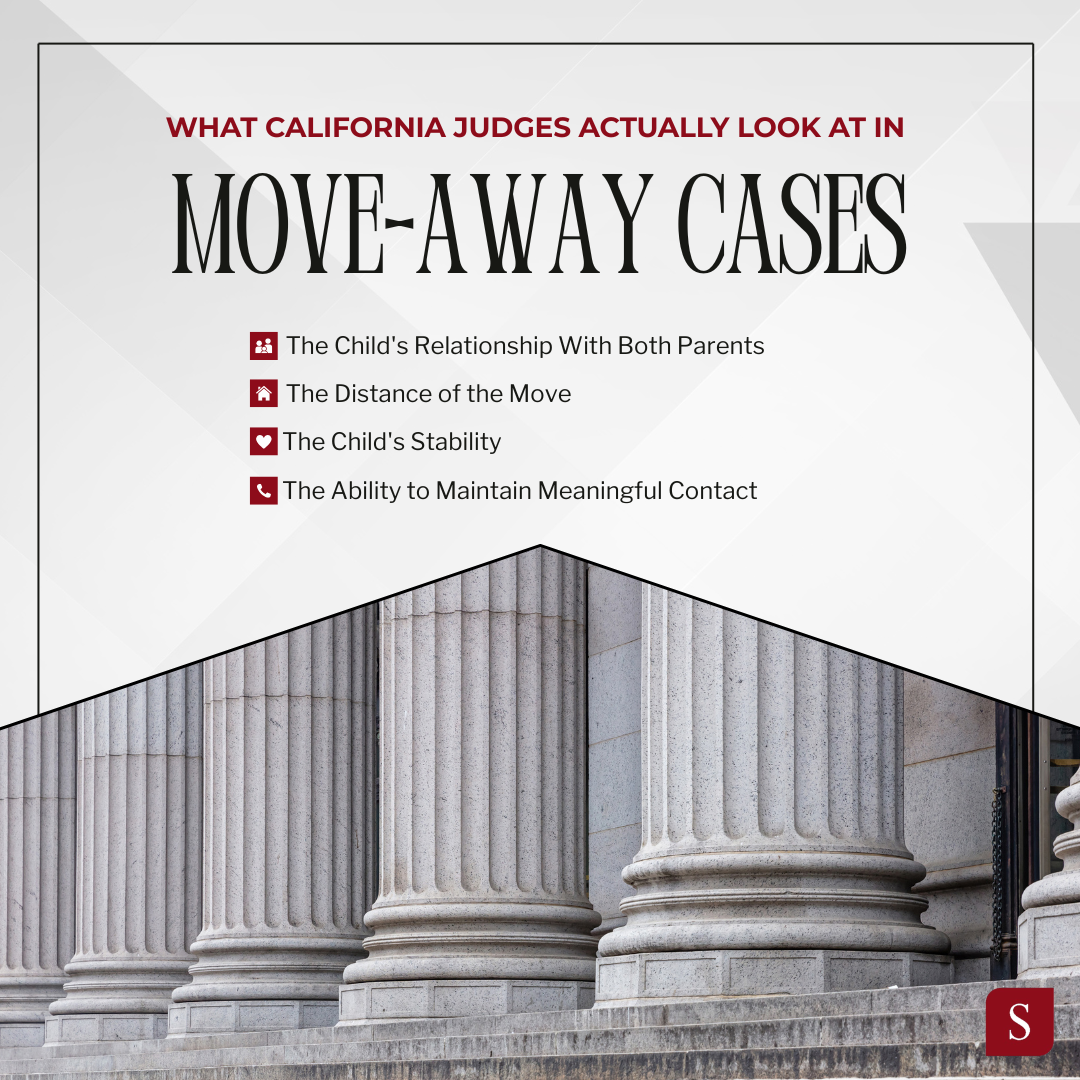
Factor 1: Stability and Continuity
Stability is often the factor that carries the most weight. Judges want to know who the children’s primary psychological parent has been, what their daily routine looks like, and how deeply they are embedded in their current community. A child who has been in the same school district for years, with established friendships, sports teams, and medical providers, is a child the court is reluctant to uproot without strong justification.
If you are the moving parent, be prepared to address stability directly. If you are the non-moving parent, documenting the specific ways your children are rooted in the community is often more persuasive than general statements about closeness.
Factor 2: The Distance and Feasibility of the Move
Not all moves are equal. A two-hour drive is a different case than a cross-country flight. Courts look at the practical feasibility of maintaining a meaningful relationship with the non-moving parent.
Drive-Distance Moves
Relocations within California or to a neighboring state often allow regular in-person time, alternating weekends, and extended school breaks. These cases tend to settle more readily because a workable long-distance schedule is easier to design.
Long-Distance and International Moves
Moves across the country or out of the country trigger more intense scrutiny. Judges know that routine weekend visits are off the table. The moving parent needs a realistic plan for how the non-moving parent will maintain a bond, including transportation logistics, financial responsibility for travel, and generous block time during school breaks.
Factor 3: The Reason for the Move
Motivation matters. Courts distinguish between moves driven by legitimate opportunity and moves that appear designed to limit the other parent’s access.
Good-Faith Reasons
A bona fide job offer with documented salary increase. A remarriage to a spouse whose employment is tied to a specific location. A return to a strong extended-family support system. Medical needs that require specialized care available only in another area. These are the reasons that tend to hold up under scrutiny.
Red-Flag Reasons
Moves that coincide suspiciously with escalating custody conflict, moves to locations with no real ties or support system, or moves that the moving parent struggles to explain in concrete terms all raise questions. A judge who suspects the move is designed to frustrate the other parent’s relationship with the children will often deny it, even without direct evidence of bad faith.
Factor 4: The Existing Custodial Arrangement
How custody is currently structured, both on paper and in practice, is a heavy factor. Courts look at:
- Whether custody is labeled as joint or sole in the existing order
- How much actual time each parent currently exercises
- Who has been the day-to-day decision-maker for school, medical, and activities
- Whether the parents have effectively co-parented or have been in continuous conflict
- Whether the current arrangement is the result of a contested court ruling or a stipulated agreement
A parent who has genuinely shared custody will face a different analysis than a parent whose involvement has been sporadic, regardless of what the order says on its face.
Factor 5: The Children’s Relationships With Each Parent
Courts assess the strength and quality of each parent’s relationship with the children separately. This is not a popularity contest. The judge wants to understand the role each parent plays in the children’s lives: who helps with homework, who attends pediatric appointments, who coaches the soccer team, who the children turn to when they are upset.
In contested cases, a Section 730 evaluator often spends significant time on this question. Their findings, documented through interviews, observations, and collateral contacts, often carry substantial weight with the court.
Factor 6: The Children’s Ages and Preferences
A four-year-old and a fourteen-year-old are different cases. Younger children generally adapt more readily to a new environment but are more dependent on their primary caregiver. Older children have stronger community ties, their own social networks, and more specific educational needs.
Under California Family Code Section 3042, children fourteen and older have the right to express a preference, and courts give those preferences reasonable weight. Judges look carefully at whether the preference is authentic or the product of parental influence. A child who says they want to stay with Mom because their friends are here is credible. A child who can recite a parent’s legal arguments verbatim is not.
Factor 7: The Ability to Maintain the Non-Moving Parent’s Relationship
Even when a move is approved, the court wants to know what the new parenting plan will look like. A moving parent who shows up with a detailed, realistic plan for maintaining the other parent’s relationship, including specific proposed schedules for extended holidays, summer, virtual contact, and shared travel costs, is in a much stronger position than one who treats the non-moving parent’s time as an afterthought.
Conversely, a non-moving parent who refuses to engage with long-distance parenting options, who takes an all-or-nothing position, often undermines their own credibility. Judges appreciate parents who can adapt.
Factor 8: The Presence of Conflict or Safety Concerns
High-conflict cases require extra attention. If there is a history of domestic violence or restraining orders, the analysis can shift significantly. A parent fleeing an abusive situation has different considerations than a parent seeking a career upgrade. Courts look at whether the move would protect or harm the children, not just whether it is convenient.
Factor 9: The Children’s Community and Extracurricular Ties
Schools, sports teams, religious communities, therapy relationships, and long-standing friendships all matter. The more deeply embedded the children are, the stronger the stability argument against uprooting them. In practice, judges rarely deny an otherwise reasonable move solely because of community ties, but these ties can tip the scales in a close case.
Factor 10: The Parents’ Ability to Co-Parent Across Distance
Long-distance parenting is hard, and judges know it. Parents who can demonstrate respectful communication, flexibility, and a shared focus on the children’s welfare often earn more latitude in relocation cases. Parents locked in continuous conflict give the court less confidence that a long-distance plan will actually work.

Mistakes That Damage a Move-Away Case
Some of the most common unforced errors we see include moving before the court rules, badmouthing the other parent to the children, refusing to propose a realistic long-distance schedule, and treating the case as a personal battle instead of a parenting decision. Any of these can shift the outcome, regardless of how strong the underlying reasons for or against the move may be. Judges evaluate parents on their behavior during the litigation, not just on their position.
On the non-moving side, equally damaging mistakes include refusing to acknowledge any scenario in which the children could adjust, making threats rather than proposing solutions, and using the litigation as leverage for unrelated issues like support or property. Judges are experienced at reading motivation, and they notice when a position is grounded in the children’s welfare versus when it is grounded in anger or strategy.
How Long These Cases Take
Contested move-away cases are not quick. From filing to final ruling, they typically take six to twelve months, and longer if a 730 evaluation is ordered. The court may enter temporary orders along the way, such as requiring the children to remain in California pending the evaluation. Parents should plan for this timeline when considering a job offer or relocation opportunity, because telling an employer you need a year to sort out custody is not always feasible. Talking to an attorney early helps you understand what is realistic before you commit to a timeline.
What This Means for Your Case
Move-away cases are won and lost in the details. Judges are not impressed by emotional arguments or abstract claims of parental love. They are looking for concrete evidence, credible planning, and a realistic understanding of what the children actually need. Both sides should expect thorough scrutiny, and both sides should prepare accordingly.
Sullivan Law & Associates represents California parents on both sides of move-away and relocation cases, from job-related moves to high-conflict international disputes. If you are considering a relocation or have just received a notice, the time to get strategic advice is now. Schedule a confidential consultation to discuss your options before your next filing deadline.